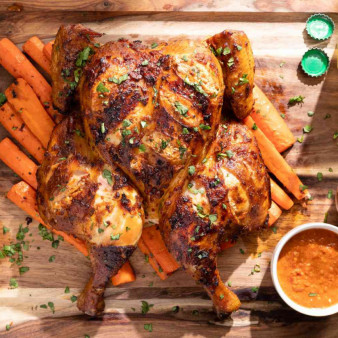


Ingredients for - Smoked Spatchcocked Harissa Chicken with Carrots
How to cook deliciously - Smoked Spatchcocked Harissa Chicken with Carrots
1. Stage
Rehydrate the chiles de arbol: Bring a small saucepan or kettle with about 2 cups of water to a boil over high heat. Place the dried chiles in a small heatproof bowl and carefully add enough boiling water to cover them—I used about 1 cup of water. Set the bowl aside for 30 minutes to allow the chiles to rehydrate.
2. Stage
Roast and peel the peppers: If you have a gas stove, set a burner to high heat. Use a pair of tongs to place a bell pepper directly on the flame. You can use two burners, one for each pepper. If you have the grill already on (you won’t need it quite yet to cook the chicken since it needs to marinate), set the peppers on the grill over high heat. For both methods, turn them as the skin blackens until fully charred all around. Transfer the charred peppers into a medium bowl and cover the bowl with a large plate to seal in the steam and loosen the skin. Once cool enough to handle, use your hands to peel off the blackened skin and remove the seeds. Roughly chop the peppers and transfer them into a food processor.
3. Stage
Toast and grind the seeds: In a small skillet set over medium heat, add the caraway and cumin seeds. Toast, stirring frequently, until they turn a light golden brown and are fragrant, about 2 minutes. Grind the toasted seeds in a spice grinder, blender, or with a mortar and pestle. Then, transfer them into the food processor. They don’t have to be finely ground. It’s okay if it’s a little coarse.
4. Stage
Make the harissa paste: Drain the rehydrated chiles, remove and discard the stems, and add the chiles into the food processor along with the garlic, 1/4 cup plus 3 tablespoons olive oil, smoked paprika, tomato paste, red wine vinegar, and 2 teaspoons salt. You can discard the chile soaking liquid. Blitz the mixture until smooth like a purée. You’ll have about 1 cup of harissa paste. Don’t have a food processor? Finely chop the chiles, peppers, and garlic on a cutting board with a sharp chef’s knife and stir with the remaining ingredients for a slightly coarser harissa. Spoon about a third of the harissa into a little serving bowl, cover, and refrigerate until you are ready to eat. You will use the remaining harissa to marinate the chicken. Harissa keeps in the fridge, covered, for a good week.
5. Stage
Spatchcock the chicken: Rest the chicken breast side up on a cutting board. Use a sharp chef’s knife to cut a few deep slashes, about 2 inches wide, through the legs and breasts to allow the harissa to soak deeper into the meat. You’ll be cutting through the skin and meat down to the bones. Flip the bird breast side down and use large kitchen scissors to cut down each side of the backbone. You will be cutting through the rib bones, not the backbone itself. Remove and discard the backbone, or perhaps save it for stock . Use your hands to open up the bird slightly, then turn it breast side up again. Use the palm of your hand and your body weight to press it down firmly over the breastbone. The aim is to flatten the bird so it cooks in a single layer.
6. Stage
Marinate the chicken: Spoon the harissa reserved to marinate the chicken onto the bird. Use your hands to rub it all over and into the slashes and crevices for maximum flavor. Set the chicken breast side up on a sheet pan, or large platter if a sheet pan will not fit into your fridge. Slide it into the fridge to marinate for a minimum of 2 hours, but I recommend 24 hours.
7. Stage
Fire up the grill for indirect grilling: For a charcoal grill: Light the coals on fire and place them in the grill along two sides, opposite each other. The chicken will cook in the center of the grill between the fire, not over it, with even heat coming from two sides. Then, add a couple lumps of wood chunks—any kind, like oak, apple, cherry, or hickory—on top of the fire. For a gas grill : If you have three burners, light two of them set to medium heat, one at each end. The chicken will cook in the center over the burner that’s off. For a two-burner grill, light just one set to medium heat. The chicken will cook over the burner that’s off. Rest a couple lumps of wood chunks directly on the lit burners so that it catches on fire and smolders as the chicken cooks.
8. Stage
Smoke the chicken: Take the marinated chicken out of the fridge. No need to wait to get it to room temperature. Place it breast side up on the grill. There shouldn’t be any lit coals or burners turned on right beneath it. The smoke from the wood chunks will come, no need to wait for it before placing the chicken on the grill. Shut the lid to trap in smoke and cook for about 1 1/2 hours. Check it once or twice, using tongs to rotate it 180 degrees to make sure it cooks evenly—the side closest to the fire will cook faster—but keep it breast side up.
9. Stage
Meanwhile, parboil the carrots: Bring a large pot of water to a boil over high heat with 1 tablespoon salt. Once boiling, add the carrots and cook for 5 minutes. Drain well into a colander set in the sink. Transfer the carrots into a medium bowl and drizzle in the remaining 1 tablespoon olive oil, the remaining 1 teaspoon salt, and 1/2 teaspoon black pepper. Set it aside.
10. Stage
Flip the chicken: After 1 1/2 hours, check the internal temperature of the chicken with a thermometer. It should be about 160°F when probed in a few places. Use tongs to flip it breast side down and keep cooking until the internal temperature is at least 165°F. Probe the chicken in a few places, say once on each leg and once on each breast. Poke the probe deep into the meat but avoid touching a bone or you will get a false reading. Also, make sure you don’t probe all the way through and out the other side—you’ll be reading your grill bars. Toward the end of cooking, you can slide it a little closer to the fire so it finishes crisping up over a higher heat but you may not need to—after all, a roast chicken in your oven gets beautifully crispy without ever seeing any flames. When it’s done cooking, slide the chicken far from the fire to keep warm while you cook the carrots. Use tongs to lay the carrots perpendicular to the grill bars directly over the fire and cook for 8 to 10 minutes flipping them regularly until lightly charred and tender all the way through.
11. Stage
Assemble and serve: Transfer the carrots onto a large serving platter. Place the chicken on top, sprinkle it with cilantro, and serve with the reserved harissa. Did you love this recipe? Give us some stars below!


