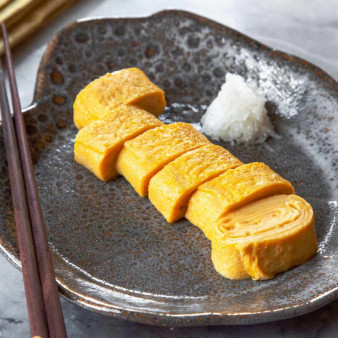


Ingredients for - Tamagoyaki
How to cook deliciously - Tamagoyaki
1. Stage
Make the dashi stock: In a small bowl or glass measuring cup, combine the 1/4 cup warm water and dashi powder. Mix with a fork until the granules dissolve. The warm water simply helps them dissolve, so don’t stress if you use room temperature or cold water.
2. Stage
Beat the eggs: In a medium bowl, add the eggs, sugar, and salt. Use a fork to beat the eggs until thoroughly combined. Try not to incorporate too many bubbles.
3. Stage
Season the eggs: Add the dashi stock, soy sauce, and mirin. Mix until the ingredients are incorporated.
4. Stage
Strain the eggs (optional): For a silkier custard-like texture, strain the eggs through a fine mesh strainer set over a liquid measuring cup with the spout—it will make pouring the egg batter into the pan easier.
5. Stage
Grease and heat the pan: Place the oil in a small bowl and dip a small, folded paper towel into it. Use the saturated paper towel to wipe the inside of a kotobuki tamagoyaki or small nonstick pan. Heat the skillet over medium heat, enough to immediately start cooking the eggs when they are added but not so hot that they brown right away, then reduce the heat to medium-low.
6. Stage
Cook the first layer: Pour a small amount of batter into the pan, just enough to fully coat the bottom. Cook until it is mostly set, with the top still slightly liquidy. Use chopsticks or a thin fish spatula to lift one end, flipping and rolling it over to the opposite end of the pan. Don’t worry if the first couple of flips are wrinkled or scrunched up. Just keep on rolling with it.
7. Stage
Add two more layers: Use the oil-saturated paper towel to wipe the skillet with more oil, lifting the cooked egg up to get some oil under it. Then pour more egg batter in, just enough to coat the bottom of the pan. Lift the cooked egg up slightly and tilt the pan so the egg batter can get under it. Cook until it’s mostly set. Roll the eggs again the opposite direction, building up layers, sort of like building a snowman. Repeat this process one more time, oiling the pan, adding more egg batter, and rolling it back the other way. You will have used half the egg batter at this point. Slide the tamagoyaki onto a serving plate or a cutting board. Make a second tamagoyaki with the remaining batter following the same process.
8. Stage
Serve the tamagoyaki: Cut the tamagoyaki into 1-inch slices to reveal the swirls inside. Serve with grated daikon radish on the side, if you’d like, or as part of a larger Japanese-inspired meal. Leftovers can be refrigerated for 3 or 4 days. Though you can serve it cold, I like to remove it from the fridge and let it sit on the counter for 30 minutes or so to take the chill off. You can also heat it up briefly in the microwave in 15-second bursts until warmed through. Did you love the recipe? Leave us stars below!


